-
-
-
- Building blocks of the data model
- Basic concepts
- Classes
- Key fields
- Local lookup lists
- Fields and data types
- Defining the columns of a table
- Relations between classes
- Global lookup lists
- Filters
- Universal connected classes
- Deleting foreign records
- Class inheritance
- Storage of personal data on test and develop environment (scrambling)
-
- Resource files
- Velocity - How does it work?
- Quick Velocity Tutorial
- Debugging velocity scripts
- Velocity Command Reference
- Script Editor Tutorial
- Using velocity for calculations
- Using predefined forms in a html design
- Velocity forms
- Data field identifiers
- Macros and methods
- Velocity library
- Velocity: using the #macro command
- velocity and xml
- Using AJAX in your velocity scripts
-
-
- Argon2 password conversion
- Introduction to security
- Secure development
- Security certification
- Security Exam
- Field properties concerning security
- Developing user groups securely
- Security considerations for user interface
- Secure file organization
- Securely using the request
- Cross Site Scripting (XSS)
- Other options concerning secure development
- Security analysis
- Secure deployment
- Secure application management
- Scrambling of testdata
- Anonymization of personal data
- Using robots.txt
- Permission settings
- Security measures
- Data encryption
-
- Search Engine Optimization
- OTP
- User Interface migration guide
- User account management
- Instructies voor implementatie van visueel editen van nieuwsbrieven
- Login as another user
- Support
- More information about moving to User Interface Version 4.0
- Standaard page layout
- Sections moved to layout
- Aanpassingen in release 2024-7
- Media library
- Aanpassingen in release 2024-10
- Analytics and Matomo
- Registration forms
- How to change names of classes and fields?
- Responsible Disclosure Policy
- How to upload a blob in Velocity?
- Aanpassingen in release 2024-2
- Instances
- Componenten in onze technologie
- Google Analytics
- Street and City helper (postcodecheck)
- Responsible disclosure-beleid
- Postcode check service (straat en huisnummer) kosten
- Expressions
- Regular Expression Reference
-
Class inheritance
While creating a data model, you might find that some classes have great resemblance. In those cases you might want to introduce a class hierarchy. A class hierarchy always has a class as root, and one or more sub classes. Those sub classes might also have their own sub classes.
Class inheritance can be used in classes related to persons. In those cases the root class is 'person'. Sub classes might be 'employee', 'customer', 'patient', etc..
In the class 'person' all common fields are defined, like 'first name', 'last name', 'email' etc.. In the class 'employee' only the employee-related fields are defined, like 'employee number', 'contract start date' or 'job description'.
Parent
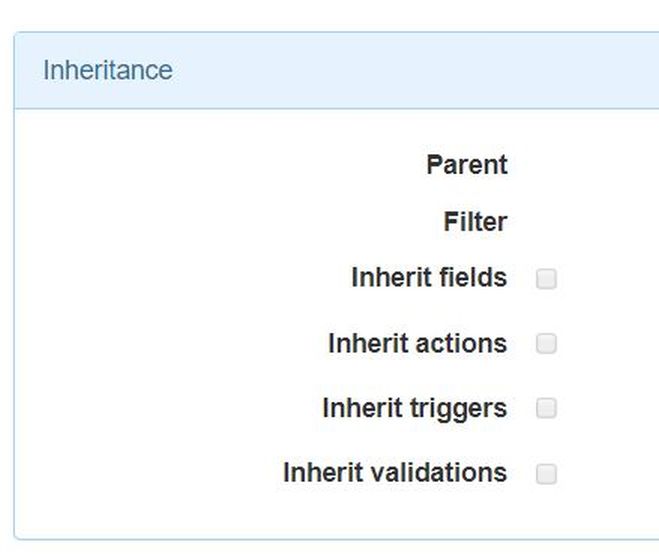
In the studio a class hierarchy is created by defining a parent class as a property of the sub class. You can select the 'parent' in the tab 'Properties' of the sub class. At the bottom you find a section with the title 'Inheritance' and here you are able to select the parent. The following items can be inherited bij selecting the checkbox:
- inherit fields
- inherit actions
- inherit triggers
- inherit validations